Bassett Limoges Austria: The Story Behind the Mark
There is something particularly appealing about old porcelain with a little mystery behind it. A plate found in an antique shop or tucked away in a family cupboard may look beautiful, but the mark on the back can raise just as many questions as it answers. One such mark is Bassett Limoges Austria, found on a wide variety of antique and vintage porcelain pieces.
The name can be confusing at first. Limoges is strongly associated with fine porcelain from France, while Austria was also an important center of porcelain production. So why would a piece made in Austria carry the word “Limoges” along with the name Bassett?
The answer has to do largely with the way china was imported, decorated, and sold in the United States around the turn of the twentieth century.
Who Was Bassett?
Bassett was associated with George F. Bassett & Co., a New York importer of china and other wares. Historical trade publications from the period list George F. Bassett & Co. among importers dealing in English, Austrian, and French dinnerware.
This is an important distinction for collectors. Bassett was not necessarily the factory that physically manufactured every piece carrying the Bassett name. Importers commonly worked with European manufacturers and brought their wares into the American market.
That helps explain why the Bassett mark appears on porcelain made in Austria.
Rather than thinking of Bassett as a single porcelain factory in the same sense as some famous European manufacturers, it is more useful to think of the name in connection with the American import trade.
Why Does It Say “Limoges”?
The word “Limoges” can cause considerable confusion among people discovering Bassett porcelain for the first time.
Limoges is a city in France famous for porcelain production, and many well-known French porcelain manufacturers used Limoges marks. But the presence of the word Limoges on a Bassett Austria piece does not necessarily mean that the particular piece was manufactured in France.
The Bassett Limoges Austria mark is associated with porcelain made in Austria and imported into the United States. Replacements, Ltd., for example, identifies Bassett’s BSS13 pattern as being crafted in Austria.
That distinction is important when identifying an individual piece.
The word “Limoges” in this mark should therefore not automatically lead a collector to classify the entire piece as French Limoges porcelain.
When Was Bassett Limoges Austria Made?
Dating these pieces can be difficult because the same basic Bassett mark appears across a substantial period.
Kovels has identified the Bassett Limoges Austria mark as being used from approximately 1890 to 1963.
That is a very broad date range, and it is one reason collectors should be cautious about assigning an exact date simply from the backstamp.
Individual pieces can often be dated more accurately by looking at the decoration, shape, construction, gilding, pattern numbers, and other markings. A particular floral design may belong to a much narrower period than the basic Bassett mark suggests.
There is particularly strong evidence of Bassett porcelain being imported around the late nineteenth and early twentieth centuries. Historical archaeological research has identified Bassett Limoges Austria fragments dating to the period around the late 1800s through the years just before World War I.
What Does the Porcelain Look Like?
Bassett Limoges Austria pieces can vary considerably. That is part of what makes collecting them interesting.
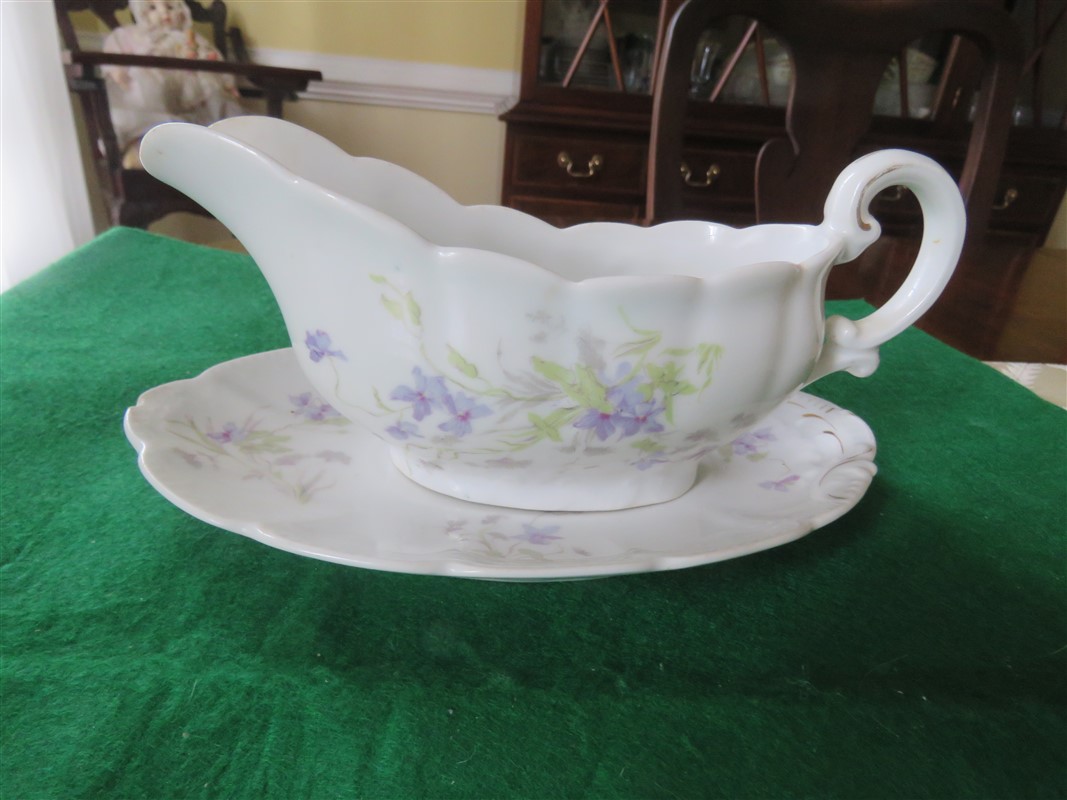
Many examples are decorated with floral designs, including roses, violets, and other flowers. Some have delicate sprays of flowers against a white or ivory background, while others feature more elaborate decoration. Gold edging and gilded details are also common.
The pieces themselves can include much more than dinner plates. Collectors and replacement dealers list cups, saucers, salad plates, bread-and-butter plates, soup bowls, serving platters, gravy boats, teapots, coffee pots, covered serving dishes, and other tableware.
Replacements, Ltd. currently catalogs numerous pieces under its Bassett Limoges Austria listings, including examples from individual patterns such as BSS13.
This variety suggests that Bassett porcelain was intended for complete or partial table services rather than simply decorative plates.
The Backstamp Is an Important Clue
When examining a piece of Bassett porcelain, the mark on the bottom is one of the first things worth checking.
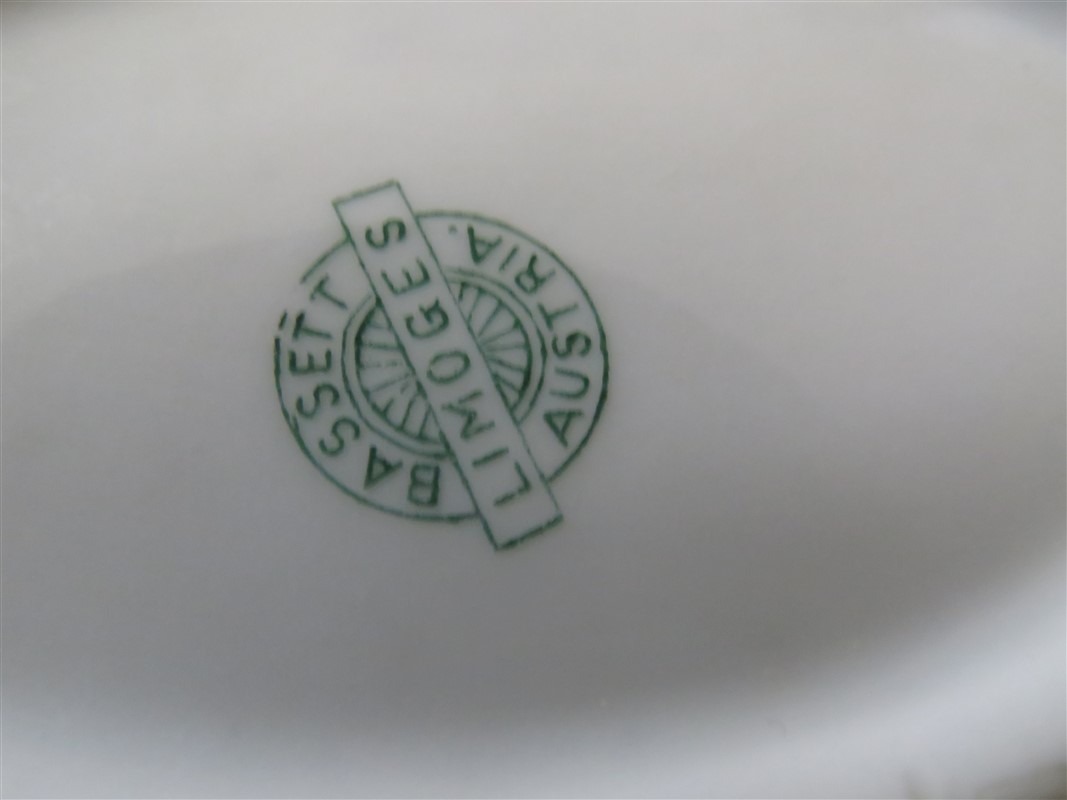
The Bassett Limoges Austria mark is commonly arranged in a distinctive circular design, with Bassett appearing above, Austria below, and Limoges across the center. Examples of the mark can be found on surviving pieces and are useful when comparing an unidentified piece with known Bassett examples.
However, the backstamp should be considered a starting point rather than the entire identification.
Collectors should also look for numbers or additional marks. A pattern number may help distinguish one design from another, while the shape of the piece can help determine whether it was intended as a dinner plate, dessert dish, serving piece, or another part of a service.
Why Do Collectors Like It?
Part of the appeal of Bassett Limoges Austria is that these pieces offer an opportunity to own genuine old European porcelain without necessarily entering the expensive world of the rarest French Limoges manufacturers.
They also have the visual qualities many people associate with turn-of-the-century tableware: delicate floral decoration, fine porcelain, graceful shapes, and touches of gold.
For some collectors, the appeal is the age. For others, it is the decoration. And for people trying to replace pieces from an inherited dinner service, finding a matching Bassett piece can be especially rewarding.
A single plate may not be worth a great deal on its own, but completing a partial service can make the collection much more useful and attractive.
Condition Matters
As with almost all older porcelain, condition has a major influence on desirability.
Look carefully for chips along the rim, hairline cracks, repairs, discoloration, and worn gold decoration. Crazing—the network of fine lines that can develop in the glaze—is another condition issue collectors should notice.
Gold trim that has become worn from years of washing is not unusual on older tableware. A piece can still be attractive with some wear, but condition should always be honestly described when buying or selling.
It is also worth remembering that an old piece does not have to be perfect to be interesting. A plate that has survived for more than a century carries some evidence of the life it has had.
A Piece of the American China Trade
Bassett Limoges Austria is an interesting reminder that antique china has a much more complicated history than the name stamped on the bottom might suggest.
European manufacturers produced the porcelain. American importers brought it across the Atlantic. American consumers purchased it for their homes, and families used it at dinner tables for generations.
Today, those same pieces may turn up in antique shops, estate sales, online marketplaces, and replacement-china collections.
The mark may initially seem confusing, but once its history is understood, it becomes much more interesting.
Bassett Limoges Austria represents a chapter in the great American trade in European porcelain—a period when beautifully decorated Austrian china found its way into American homes and became part of everyday life.
That is perhaps the most appealing thing about old china. A plate is never just a plate. It can be a piece of manufacturing history, a reminder of changing tastes, and sometimes a small survivor from a household that disappeared long ago.