
Canonsburg Pottery: The History of an American Dinnerware Company
Canonsburg Pottery was an important American manufacturer of dinnerware based in Canonsburg, Pennsylvania. The company operated for most of the twentieth century and produced a wide range of tableware for American households, hotels and other customers. Today, its products are collected not only for their patterns and designs but also as examples of the long history of American pottery manufacturing.
The Company Begins
The story of Canonsburg Pottery begins in 1900. The business was established as the Canonsburg China Company, with local investors helping bring a pottery factory to Canonsburg.
Construction of the factory began in 1900, and the plant went into operation in early 1901. A contemporary history of Washington County described a substantial operation for its time. By 1910, the factory had thirteen kilns and employed approximately 200 people.
The factory produced semi-porcelain dinnerware as well as hotel ware, toilet ware and other ceramic products. Its products were shipped well beyond the local area, with contemporary records noting distribution to markets throughout the United States.
The original company did not retain the Canonsburg China Company name permanently. In 1909, the business was reorganized as the Canonsburg Pottery Company.
That distinction is useful to collectors today. A piece marked Canonsburg China generally belongs to the earlier period, while pieces marked Canonsburg Pottery Company represent the much longer period that followed.
Early Canonsburg China
Some of the earliest surviving Canonsburg pieces date from approximately 1901 through 1909.
Examples from this period show that the company produced considerably more than plain household dishes. Early pieces can feature elaborate floral decoration, birds, colored borders and painted or printed ornamentation. Plates, bowls, pitchers, serving dishes, cups and saucers are among the surviving forms.
The backstamp is particularly useful when identifying early pieces. Examples in the collection of the Senator John Heinz History Center include a green mark with the word “CANONSBURG” surrounding “CHINA.”
The History Center’s collection also demonstrates the variety of shapes and designs produced during these early years. One documented early pitcher, for example, carries a Canonsburg China mark along with the number 1053.
These surviving pieces provide a useful reminder that Canonsburg was already producing decorated tableware during its first decade of operation.
The George Family
The early history of Canonsburg Pottery is closely connected with the George family and with the pottery industry of western Pennsylvania and eastern Ohio.
W. S. George was involved in the establishment and management of the original Canonsburg operation. Another member of the family, W. S. George, later became associated with a separate pottery operation in Canonsburg.
The two businesses are sometimes confused because of their family connections and because both produced American dinnerware in Canonsburg. They were, however, separate companies.
This is one reason collectors should pay close attention to the exact wording of a backstamp rather than assuming that every piece made in Canonsburg came from the same pottery.
Growing Into a Major Manufacturer
Canonsburg Pottery continued to expand its production during the first half of the twentieth century.
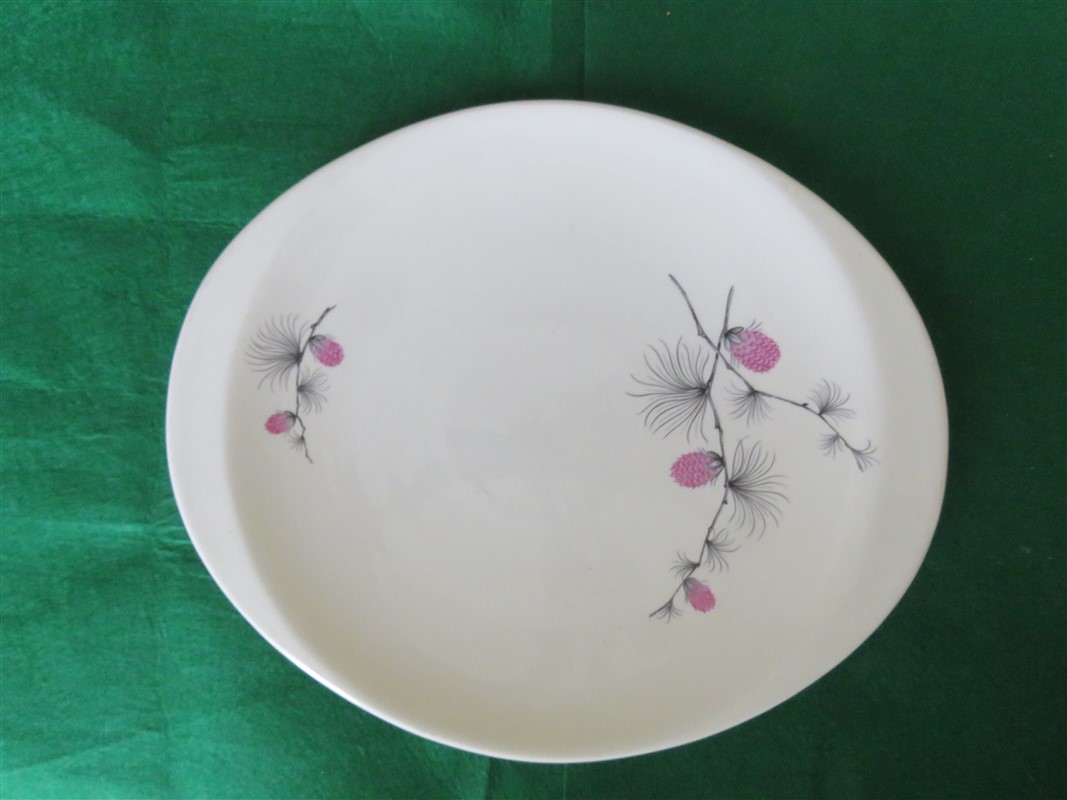
Its dinnerware was made in many shapes and decorative styles. Some pieces were relatively simple, while others featured elaborate floral decoration, colored borders or other ornamentation.
As American tastes changed, Canonsburg changed its products as well. The company eventually produced patterns ranging from traditional floral designs to the more colorful and modern styles associated with the middle decades of the twentieth century.
The company’s long history means that there is no single “Canonsburg look.” A collector examining an early twentieth-century Canonsburg plate may see very little resemblance to a Canonsburg pattern made fifty years later.
From Hand Decoration to Decals
Changes in manufacturing technology also affected Canonsburg’s products.
Early decorated dinnerware included hand-painted work. As production methods became more efficient, decals and other mechanical decorating processes became increasingly important.
This change allowed manufacturers to produce decorative dinnerware in larger quantities while maintaining consistent designs. Canonsburg became particularly well known for its decorated dinnerware, and many of the company’s later patterns are recognizable by their colorful printed designs.
For collectors, the method of decoration can sometimes provide another clue when attempting to determine the approximate age of a piece, although it should not be used by itself to establish a date.
The Steubenville Connection
One of the most interesting chapters in Canonsburg’s history occurred in 1959, when Steubenville Pottery in Ohio ended production.
Canonsburg acquired molds and equipment from Steubenville. As a result, some Steubenville patterns continued to be produced after the original factory had closed.
Among the patterns associated with this arrangement were Rose Point and Adam Antique. Canonsburg produced these patterns under the Steubenville name during the 1960s.
This is an important point for collectors. A piece may carry a Steubenville identification even though the actual piece was manufactured by Canonsburg after the Steubenville factory had closed.
The history also illustrates how molds, patterns and production equipment could move from one American pottery company to another as factories closed or changed ownership.
Canonsburg Dinnerware in American Homes
Much of Canonsburg’s production was intended for ordinary use rather than for display as a collectible.
Families purchased dinner plates, cups, bowls and serving pieces for everyday meals and entertaining. The company also produced hotel ware and other commercial products.
That practical history is part of the appeal of vintage Canonsburg today. Many surviving pieces show normal evidence of use because they spent decades in kitchens and dining rooms.
At the same time, some pieces have survived in excellent condition, including examples that saw little use.
The Final Years
Canonsburg Pottery remained in operation for more than seventy years.
The company faced increasing difficulties during the 1970s as the American pottery industry dealt with foreign competition, changing economic conditions and increased regulatory requirements.
A major fire damaged the Canonsburg factory in 1975. The company was subsequently sold to Angelo Falconi.
Historical sources differ slightly concerning the final date. The Senator John Heinz History Center identifies 1977 as the end of Canonsburg Pottery’s operation, while other historical references describe the factory as having remained closed after the 1975 fire and place the final disposition of the company’s assets in 1978.
For that reason, the safest description is that Canonsburg Pottery’s manufacturing operation ended in the late 1970s.
Identifying Canonsburg Pottery Today
The underside of a piece is usually the best place to begin when identifying Canonsburg pottery.
Look for the manufacturer’s name, the wording of the backstamp, numbers and other markings. Then examine the shape, size, colors and decorative pattern.
A number on the underside can be useful, but it should not automatically be assumed to be the pattern number. Canonsburg pieces can contain several different types of identifying marks, and the evidence should be considered together.
The company’s long production history also means that the same general type of item can exist in very different forms. A cup from the early 1900s and a cup from the 1960s may have completely different shapes, decoration and markings.
Canonsburg Pottery Today
Canonsburg pottery remains readily identifiable in the vintage dinnerware market because so many pieces were produced during the company’s long operating history.
Collectors pursue complete dinner services, individual patterns, unusual serving pieces and replacement pieces for sets they already own. Some people are particularly interested in the early Canonsburg China Company period, while others prefer the colorful designs produced during the middle decades of the twentieth century.
For people who already own Canonsburg dinnerware, individual replacement pieces can be especially useful. A missing plate, cup, bowl or serving piece can sometimes be located decades after the original dinnerware was purchased.
An Important Part of American Pottery History
Canonsburg Pottery represents more than a collection of vintage dinnerware patterns. Its history reflects the development of American manufacturing during the twentieth century.
The company began in 1900 as the Canonsburg China Company, grew into a substantial pottery manufacturer, adapted its production methods as technology changed, acquired equipment and molds from another American pottery, and eventually became one of the many American pottery companies that disappeared during the difficult years of the 1970s.
The factory is gone, but the products remain.
Canonsburg plates, cups, bowls, pitchers and serving pieces can still be found in homes and collections across the country. Each piece provides a small connection to the history of American-made dinnerware and to a Pennsylvania company that produced tableware for generations of American consumers.
Sources: Senator John Heinz History Center, Canonsburg Pottery collection; Century History of the City of Washington and Washington County, Pennsylvania; and historical references concerning Steubenville Pottery and its transfer of molds to Canonsburg.