
The Story of Caleca Dinnerware
Caleca dinnerware has its roots in Patti, a town on the northern coast of Sicily where pottery making has been part of the local tradition for centuries. The area has long been associated with deposits of clay suitable for making terracotta and ceramics, helping establish Patti as an important center of pottery production.
The Caleca family became closely associated with that tradition. The family has been involved in ceramic production for generations, with the history of the business reaching back roughly 250 years. During that long history, the pottery tradition of Patti developed from a local craft into a business whose products reached markets well beyond Sicily.
Traditional Caleca production included practical household pottery as well as decorative pieces. Among the products associated with the company were cooking vessels, serving pieces and other ceramic articles. One traditional product was the couscousiera, a vessel used in the preparation of couscous and closely associated with Sicilian and Mediterranean cooking traditions.
The company’s history also reflects changes in the way household goods were manufactured. During the twentieth century, traditional ceramic cookware faced increasing competition from inexpensive industrial materials, including aluminum. Ceramic production declined during the 1940s as aluminum cookware became more widely used. The Caleca tradition nevertheless survived and eventually developed into a modern ceramic manufacturing operation.
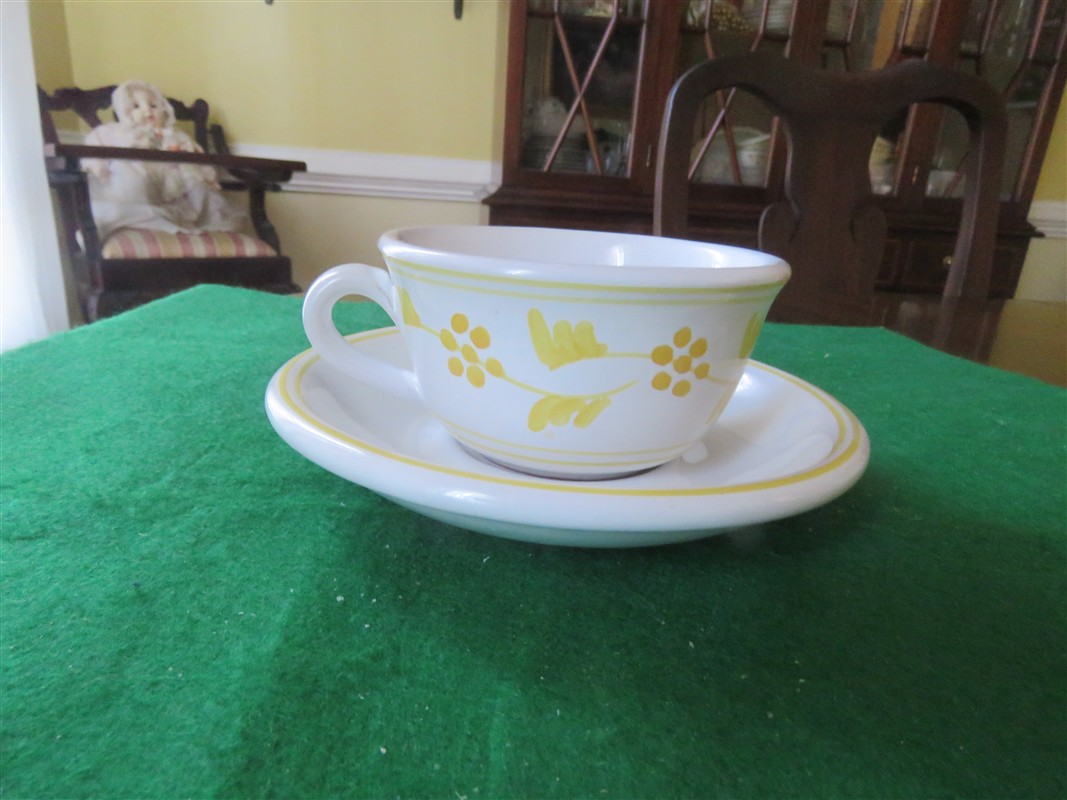
Caleca became particularly recognizable for its colorful hand-painted dinnerware. Rather than relying on the restrained decoration found on much American tableware, Caleca pieces often feature strong colors, floral motifs, geometric borders and informal brushwork. The decoration gives the pieces a distinctly Italian character while retaining their practical purpose as tableware.
Caleca dinnerware was manufactured in Italy, and the company developed ceramic bodies intended to provide durability while retaining the character of traditional earthenware. Hand painting and high-temperature firing were important parts of the production process.
Over the years, Caleca produced numerous dinnerware patterns. Some were available for only a relatively short period, while others remained in production longer. Patterns associated with the Caleca name include Meadow, Belvidere, Greca and Toscana, among many others.
The variety of Caleca patterns is one reason the dinnerware remains interesting to collectors and people looking for replacement pieces. Caleca produced much more than ordinary dinner plates. Its lines included salad and luncheon plates, bowls, mugs, serving bowls, platters, baking pieces, storage containers and a variety of table accessories.
Caleca also developed a presence in the United States. During the late twentieth century, Caleca USA operated in New Jersey. The American operation expanded beyond simply distributing Italian ceramic tableware and became involved in manufacturing as well. This helped Caleca serve the American market while maintaining its connection to Italian ceramic traditions.
Caleca dinnerware found a receptive market in the United States. Its combination of practical tableware and colorful decoration offered something different from the more uniform designs commonly found in American dinnerware. The hand-painted appearance also gave individual pieces a character that could make a table setting feel less formal and more distinctly Mediterranean.
Today, discontinued Caleca patterns can be found in the secondary market. Some patterns are relatively easy to locate, while others are considerably harder to find. Individual pieces can also become difficult to replace when a particular pattern has been out of production for many years.
Caleca is therefore more than simply a name found on vintage dishes. Its dinnerware represents the continuation of a Sicilian ceramic tradition into modern tableware. The combination of an old pottery-making heritage, Italian manufacture and distinctive decoration gives Caleca a recognizable place in the history of twentieth-century dinnerware.
For collectors, one of the attractions of Caleca is that no single pattern tells the entire story. The company’s extensive range of designs produced dinnerware that could be colorful, rustic, formal or highly decorative. Individual pieces can therefore look quite different from one another while still belonging to the Caleca tradition.
That mixture of traditional craftsmanship and changing twentieth-century design is what makes Caleca dinnerware worth preserving. The pieces were made to be used at the table, but they also carry the visual character of the Sicilian pottery tradition from which the Caleca name developed.
Caleca dinnerware remains a good example of how an old European ceramic tradition adapted to the modern dinnerware market while retaining a strong sense of place and identity. For those who appreciate vintage tableware, its colorful patterns and Italian origins make Caleca an interesting part of the broader history of dinnerware.