Understanding Lenox Backstamps: History, Identification, and American Manufacturing
Lenox china has a distinguished history of American porcelain manufacturing. Founded in New Jersey in the late nineteenth century, the company became one of America’s best-known producers of fine china, dinnerware, and decorative porcelain.
For collectors, the markings on the bottom of a Lenox piece provide useful clues about its age, origin, and manufacturing history. The familiar green and gold wreath marks are particularly recognizable, but understanding them requires looking at the company’s history as well as changes in its production facilities.
A backstamp can help establish an approximate date, although it should not be treated as an exact manufacturing record.
The Beginning: Ceramic Art Company (1889–1906)
Walter Scott Lenox established the Ceramic Art Company in Trenton, New Jersey, in 1889. His original objective was to produce high-quality decorative porcelain that could compete with the finest European products.
The company’s early work included Belleek-style porcelain and individually decorated pieces.
Early examples may carry the Ceramic Art Company name, the initials CAC, or markings associated with Lenox Belleek.
In 1906, the company adopted the Lenox name, beginning a new chapter in its history and introducing the recognizable wreath backstamp.
The Introduction of the Lenox Wreath (1906)
The familiar Lenox mark features a capital letter L enclosed within a wreath, with the name LENOX beneath it.
This design became the company’s standard identifying mark and remained in use, with variations, until 1989.
The wreath appeared in different colors over the years. Green is particularly associated with earlier Lenox production, while gold became the standard color in the 1950s.
Collectors should remember that color alone does not establish an exact production date.
Green Wreath Backstamps (1906–Approximately 1953)
The green wreath is one of the most recognizable early Lenox markings.
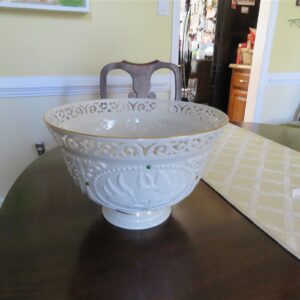
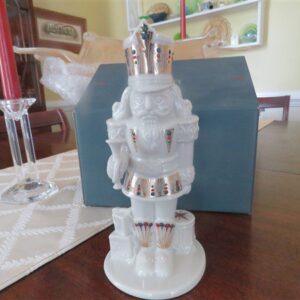
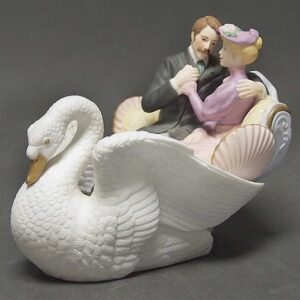


The familiar version features a capital L surrounded by a green wreath, with the name LENOX beneath it.
Around 1930, the words MADE IN U.S.A. were added beneath the company name. This provides an additional identification clue.
As a general guide:
- Green wreath without MADE IN U.S.A.: approximately 1906–1930.
- Green wreath with MADE IN U.S.A.: approximately 1930–1953.
There were variations in the markings, including differences in color and lettering. These dates should therefore be considered approximate rather than absolute.
Gold Wreath Backstamps (Approximately 1953–1989)
Around 1953, gold became the standard color for the familiar Lenox wreath mark.
The basic design remained recognizable, with the capital L enclosed in a wreath and the company name beneath it.
Many popular Lenox dinnerware patterns were produced during this period.
The gold wreath is commonly encountered on mid-century and later twentieth-century Lenox china. Additional pattern names and production markings may also appear on individual pieces.
A gold wreath is a useful indication of later production, but it should be considered alongside other markings when dating a particular item.
The 1989 Backstamp Redesign
In 1989, Lenox introduced a redesigned backstamp created by architect Michael Graves.
The new design replaced the traditional wreath presentation with a contemporary company mark.
This change provides an important dividing point in Lenox backstamp history. Pieces carrying the redesigned mark belong to the later period of the company’s production.
Lenox Manufacturing: From Trenton to North Carolina
Understanding Lenox backstamps is only part of the company’s history. Its manufacturing locations also changed considerably over the years.
Lenox began in Trenton, New Jersey, where it established its reputation for fine American porcelain.
In 1954, the company moved its production to Pomona, New Jersey. Trenton remained associated with the company’s history, but it was no longer the center of Lenox manufacturing.
During the 1980s, Lenox began expanding its manufacturing operations into North Carolina.
Oxford, North Carolina
In January 1985, Lenox opened a manufacturing facility in Oxford, North Carolina, and transferred giftware production there.
The Oxford facility became an important part of the company’s American manufacturing operations.
In 2002, Lenox expanded its Kinston facility to accommodate production previously undertaken in Oxford. The Oxford factory subsequently closed in 2007.
Kinston, North Carolina
Lenox opened its fine china dinnerware manufacturing facility in Kinston, North Carolina, in 1991. The factory had been built in 1989.
Kinston became particularly important to Lenox’s production of fine bone china.
In November 2005, Lenox transferred its remaining fine china dinnerware production from Pomona, New Jersey, to Kinston.
The Kinston factory produced numerous popular Lenox patterns and became an important part of the company’s American manufacturing heritage.
In April 2020, Lenox announced the closure of the Kinston facility, citing the economic downturn associated with the COVID-19 pandemic.
The closure ended a significant chapter in American fine china manufacturing.
What Does Made in U.S.A. Tell You?
The words MADE IN U.S.A. are useful when identifying Lenox pieces, but they do not identify the particular factory where an item was produced.
Lenox manufactured products in several American locations over its history, including Trenton, Pomona, Oxford, and Kinston.
Consequently, a piece marked MADE IN U.S.A. should not automatically be identified as having been manufactured in Trenton.
The backstamp, pattern, manufacturing period, and other available information must be considered together.
How to Identify and Date Lenox China
When examining an unfamiliar piece of Lenox china, look for several identifying details:
- Wreath color: Determine whether the wreath is green, gold, or another color.
- Company name: Look for LENOX or an earlier company identification.
- Country of origin: Check for MADE IN U.S.A. or another country designation.
- Pattern name: Some pieces identify the pattern directly on the back.
- Factory and production markings: Additional letters and numbers may help identify the shape, pattern, or production details.
Photographing the entire backstamp is often helpful when researching an unfamiliar piece.
Remember that the backstamp usually provides an approximate manufacturing period rather than an exact date.
Why Lenox Backstamps Matter to Collectors
Lenox has produced an extensive range of dinnerware, decorative porcelain, giftware, and collectible pieces.
Its backstamps tell part of the story of an American manufacturer whose operations evolved over more than a century.
The early green wreath, the later gold wreath, and the 1989 redesign provide useful identification clues. The company’s movement from New Jersey to North Carolina adds another important dimension to understanding its manufacturing history.
For collectors, recognizing these markings is a practical first step toward identifying and researching vintage Lenox.
Whether you are assembling a dinner service, replacing a missing piece, or collecting discontinued patterns, understanding the history behind the Lenox backstamp can make the process considerably easier.
Explore Lenox at Third Vintage: Browse our selection of Lenox dinnerware and collectibles, including individual replacement pieces and discontinued items.
Explore Lenox at Third Vintage: Discover our selection of Lenox dinnerware and collectibles, including individual replacement pieces and discontinued items.
Some Information About Lenox Backstamp History
Historical sources
I used institutional, corporate, and contemporary reporting sources to establish the manufacturing chronology:
– Rutgers University – Lenox Incorporated Records — company chronology, including Oxford and Kinston.
– WRAL – Lenox Oxford Factory Closure — reporting on the Oxford closure.
– SEC Filing – Transfer of Pomona Production to Kinston — corporate documentation of the 2005 transfer.
– Lenox Corporation – Kinston Factory Closure — original 2020 announcement.
– Trenton Potteries Society – Lenox Backstamp History — historical backstamp chronology.
Third Vintage Copyright Notice
© 2026 Christian-Woods Group, Inc. All rights reserved.
All original content on Third Vintage is protected by copyright. No part of this article may be reproduced, republished, or distributed without prior written permission. Brief excerpts may be quoted with clear attribution and a link to the original Third Vintage article.